Resources
Below are some indicators of what babies are
capable of at different stages of development
and what interests them about books and
language:
|
0 to 3
months
-
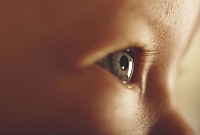
Begin to be interested in what
is going on around them and to
have some control of head
movement
-
Like to look at patterns,
instead of solid colours, and
prefer sharp contrast
-
Enjoy someone smiling at them
and talking to them
-
Can produce sounds and begin to
coo
-
Books made of stiff cardboard or
soft vinyl with simple large
pictures or designs set against
a contrasting background are
best
|
 |
 |
4 to 6
months
-
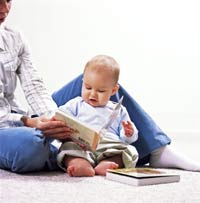
Cooing is well established
-
Begin to experiment with sounds
-
Become able to reach and grasp,
and begin to sit up
-
Books are something to explore
with mouth and hands, so
cardboard and vinyl are best
-
Express great interest in
nursery rhymes and when sung to
|
|
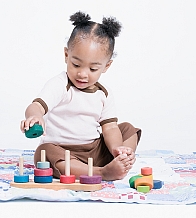
7 to 9
months
-
Very busy exploring objects with
their hands
-
Begin to crawl and explore the
environment
-
Babbling (syllable repetition,
eg. ba-ba-ba) becomes part of
the repertoire
-
Understand much of what is said
to them
-
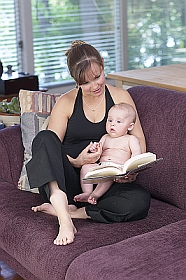
Can turn pages in board books
-
Paper is something to crumple
and tear and taste, so keep
books with paper pages until
later
-
Can point to objects on a page
and enjoy having them named, but
not yet ready to follow a story
|
 |
 |
9 to 12
months
-
Very skillful with their hands
-
Learning to walk is a high
priority
-
Begin to say first words and
respond to simple questions and
directions
-
Beginning to make connections
between objects and events
-
Board books with familiar
objects and activities are very
interesting
-
Listen with interest to talk
about what they are looking at
in books, and attempt to repeat
words
|
|
12 to 18
months
-
Language blossoms
-
Produce a lot of jabbering which
sounds like actual speech
-
May start to sing along when
sung to or when listening to
recordings
-
Enjoy books with songs and
repetitive phrases
-
Begins to be interested in and
able to follow simple stories
about little ones that relate to
their own experience
|
 |
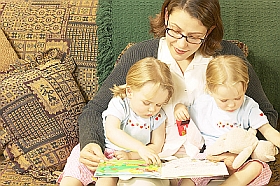 |
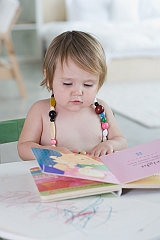
19 to 30
months
-
Begin to form simple sentences
and actual conversation is
possible
-
“Why?” becomes continuous, as a
technique for obtaining
information, but often also in
order to keep a conversation
going
-
Actual stories are enjoyed now -
about other children, about how
things work, and what makes
thing happen
-
Books with an illustration and a
little text on each page are
best
-
Will spend a lot of time looking
at illustrations
-
Love predictable books – ones in
which sentences are repetitive
and rhyme
|